
Quick answer
Five common possibilities are mineral sediment in a storage tank, pipes expanding or moving, a valve or flow restriction, water-pressure changes, and a component fault. Repeated loud noises, leaks, overheating, or a burning or gas odor should not be ignored.
For water heater making a loud knocking noise, the most useful first step is to identify the symptom safely and record when it occurs. Do not open a gas or electrical appliance or bypass a safety device to test a theory.
Readers searching for water heater making a loud knocking noise should separate observations from assumptions: a symptom can point to several causes, and the equipment needs a site-specific diagnosis before a repair is chosen.
1. Sediment at the tank bottom
Minerals can settle in a storage tank. When heating begins, water trapped beneath a layer of sediment can create popping or rumbling sounds. Noise may develop gradually and can accompany slower recovery.
Do not open or drain a hot tank as a quick fix. Ask whether a flush or maintenance assessment is appropriate for the unit’s condition and manufacturer instructions.
2. Pipes moving as they heat
Hot-water pipes expand and contract. If a pipe is tightly constrained or rubs a wall, framing, or cabinet, the movement can sound like a knock or tap.
Notice whether the sound comes from the pipe route rather than the tank itself. Do not remove wall panels or alter pipe supports without knowing what is behind them.
3. Valve or flow restriction
A partially restricted valve or a change in flow can create vibration, chatter, or a hammer-like sound. The sound may appear when a fixture starts or stops.
Record which tap or appliance triggers the sound and whether other fixtures are affected.
4. Pressure changes or water hammer
A rapid change in water flow can create a thud in the plumbing. The source may be a valve or a pipe system issue rather than the heater’s burner or element.
Tell the provider whether the sound occurs when a tap closes, a washing machine stops filling, or a toilet valve shuts off.
5. A component or safety issue
A new sound paired with a leak, temperature swings, a fault code, repeated shutdown, or a burning smell may signal a problem that needs more than routine maintenance.
Stop troubleshooting if safety signs appear. Do not bypass controls or remove access panels.
A water heater making a loud knocking noise should be described by timing: during heating, when a fixture closes, or throughout the day.
A water heater making a loud knocking noise should be checked with the timing recorded, especially if the sound is new or recurring.
For this question—water heater making a loud knocking noise—use the table below to compare the possible explanations and the next useful action, rather than replacing a part based on one clue.
What to do next
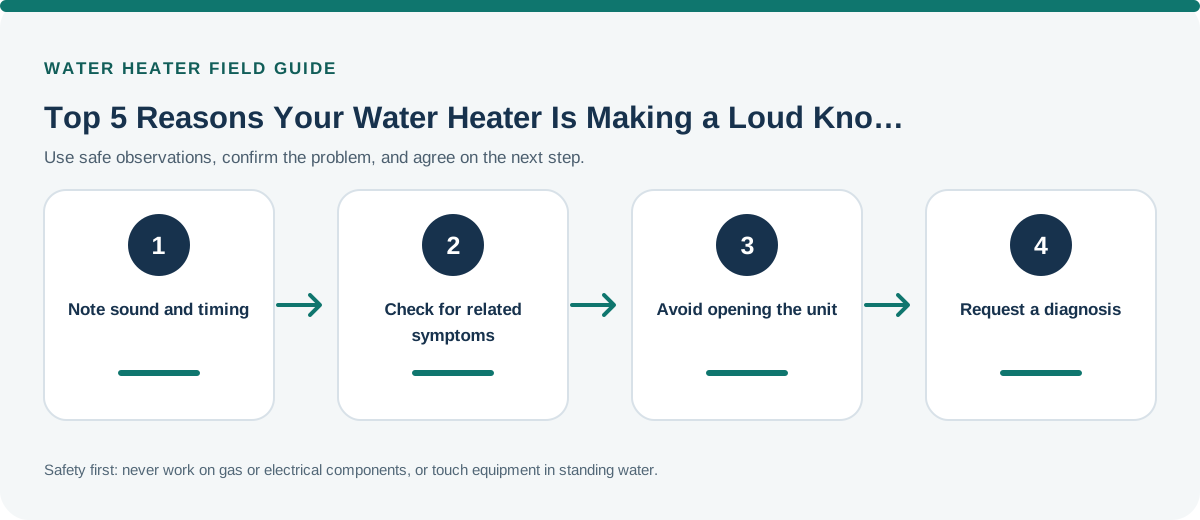
Use this short sequence to collect useful information before arranging service:
- Listen from a safe distance and write down when the sound occurs.
- Check whether the noise follows one fixture or occurs when the heater starts heating.
- Look for visible leaks or fault indicators without removing covers.
- Call for diagnosis if the sound is loud, new, recurring, or paired with performance changes.
Visual summary
Quick comparison table
| Sound or timing | Possible explanation | What to tell the provider |
|---|---|---|
| Popping/rumbling during heating | Sediment may be involved | Ask whether a tank flush or condition assessment is appropriate. |
| Knock when a faucet closes | Water hammer or pipe movement may be involved | Describe the fixture and timing; request a plumbing-system check. |
| Hiss or whistle near a valve | Flow restriction or valve behavior may be involved | Do not adjust a relief valve; request assessment. |
| Noise plus leak, odor, or shutdown | Possible urgent fault | Prioritize safety and call about prompt assessment. |
Benefits and trade-offs
What helps
- Recording the sound and its timing gives the provider useful diagnostic information.
- Addressing a confirmed maintenance issue may improve performance.
What to avoid or consider
- Noise does not prove that sediment is the cause.
- Repeated flushing or DIY valve work can be inappropriate for a corroded or damaged unit.
For top 5 reasons your water heater is making a loud knocking noise, use this table as a comparison aid, not a substitute for site-specific diagnosis; equipment design, installation, condition, and property requirements can change the right response.
Frequently asked questions
Is a loud water heater dangerous?
Not every noise is an emergency, but new loud sounds paired with leaks, overheating, gas odor, burning smell, or shutdowns deserve prompt attention.
Should I flush the tank myself?
Only if you understand the equipment instructions and can do so safely; hot water and pressurized discharge can cause burns. If the unit is old or corroded, get advice first.
Can pipe noise sound like a heater problem?
Yes. Pipe expansion, valve vibration, and water hammer can sound as if the tank is knocking.
What details should I give the provider?
Describe the sound, when it happens, the unit type, any changes in hot-water supply, visible leaks, and whether a specific fixture triggers it.
What is the safest first step for water heater making a loud knocking noise?
For water heater making a loud knocking noise, identify the symptom safely, record when it occurs, and stop troubleshooting if gas, electrical, or active flooding hazards are present.
Final takeaway
Do not diagnose a water heater by sound alone. The timing, location, and accompanying symptoms are more useful than the word “knocking”; record them and seek diagnosis when the noise is persistent or paired with other faults.
For water heater making a loud knocking noise, keep the immediate safety steps separate from the longer-term repair or replacement decision. Confirm the provider, fee policy, and written scope before authorizing work.
For a local installation, confirm current permit and inspection requirements with the authority responsible for the exact property. The City of Boca Raton publishes electric and gas/tankless changeout guidance for work within city jurisdiction.