
Quick answer
Scale can reduce heat transfer, contribute to popping or rumbling in storage tanks, and restrict flow through some components. Confirm water hardness with a reliable local water-quality report or appropriate test before choosing a treatment or changing the heater.
For hard water impact on water heater, the most useful first step is to identify the symptom safely and record when it occurs. Do not open a gas or electrical appliance or bypass a safety device to test a theory.
Readers searching for hard water impact on water heater should separate observations from assumptions: a symptom can point to several causes, and the equipment needs a site-specific diagnosis before a repair is chosen.
How scale develops
Minerals that remain dissolved in cooler water can precipitate as temperature changes and form deposits. In a storage tank, sediment may settle at the bottom; in some tankless heat exchangers, mineral scale can restrict small passages and affect heat transfer.
A sound or reduced flow may have another cause, so do not assume scale without a diagnosis.
What symptoms may look like
Popping, rumbling, slower recovery, reduced flow, or recurring maintenance needs can be clues. These symptoms can also result from other faults, including valves, heating components, controls, or plumbing restrictions.
Record the symptoms and whether they began gradually. If there is a leak, burning smell, gas odor, or electrical problem, address safety first.
Confirm local water conditions
Water hardness can vary by utility source, building, treatment equipment, and plumbing. Use the current water-quality report for the exact service area or have the water tested if the question is important to equipment selection.
Avoid purchasing a softener or chemical treatment based only on a generic statement that all local water is hard.
Maintenance should fit the equipment
Tank flushing, tankless descaling, anode inspection, and treatment options depend on the equipment design and its instructions. Incorrect flushing or chemical use can damage a system or create a burn hazard.
Ask what maintenance is appropriate, how often it is needed under the measured conditions, and whether a proposed treatment affects warranty coverage.
To understand hard water impact on water heater performance, confirm the property’s water chemistry before selecting treatment.
For this question—hard water impact on water heater—use the table below to compare the possible explanations and the next useful action, rather than replacing a part based on one clue.
What to do next
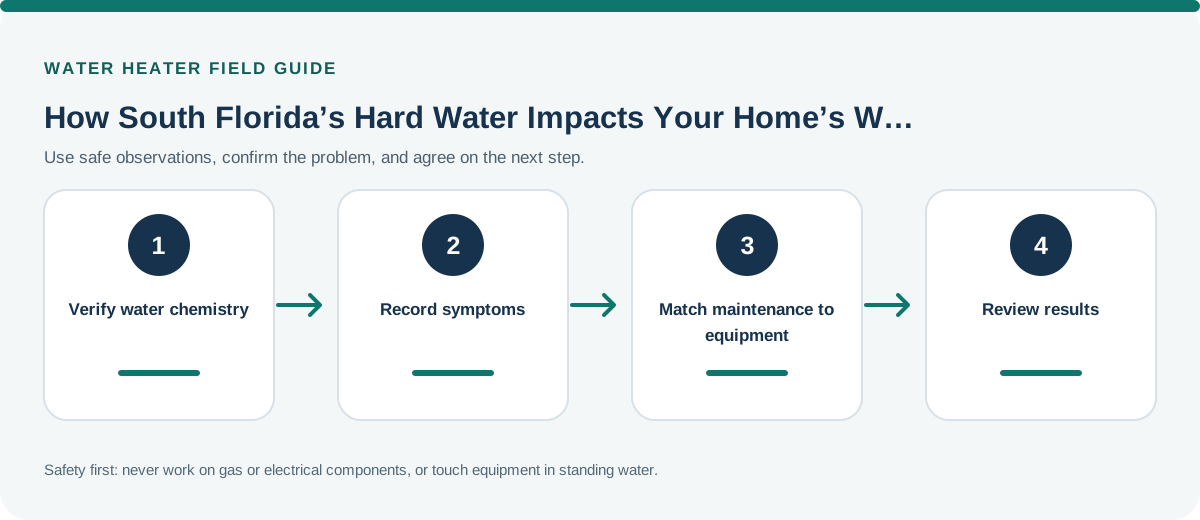
Use this short sequence to collect useful information before arranging service:
- Check the current water-quality information for your utility or property.
- Record symptoms such as noise, reduced flow, slow recovery, or recurring faults.
- Ask a provider to distinguish scale from other possible causes.
- Use an equipment-appropriate maintenance plan and verify treatment options before investing in water treatment.
Visual summary
Quick comparison table
| Observation | Possible relationship | Useful action |
|---|---|---|
| Storage tank popping or rumbling | Sediment may be present, but other causes are possible | Ask whether inspection or flushing is appropriate for the tank’s condition. |
| Tankless flow or temperature changes | Scale or a component/flow issue may be involved | Ask for system-specific diagnosis and descaling requirements. |
| White mineral deposits at fixtures | May indicate mineral content in the water | Confirm water chemistry before selecting treatment. |
| Repeated heater faults after treatment changes | Water chemistry or treatment equipment may be affecting operation | Share the treatment system and maintenance history with the provider. |
Benefits and trade-offs
What helps
- Measured water chemistry can help target maintenance and avoid unnecessary treatment.
- Correct maintenance may support performance and reduce avoidable scale-related issues.
What to avoid or consider
- Assuming hard water without testing can lead to unnecessary equipment purchases.
- Improper flushing or chemical descaling can damage equipment or cause burns.
For how south florida’s hard water impacts your home’s water heater, use this table as a comparison aid, not a substitute for site-specific diagnosis; equipment design, installation, condition, and property requirements can change the right response.
Frequently asked questions
Does every Boca Raton home have hard water?
Water conditions vary by source, building, and treatment. Check the current utility report or test the property instead of assuming all homes are alike.
Can hard water make a heater noisy?
Mineral deposits may contribute to popping or rumbling in some storage tanks, but sound alone does not confirm scale.
Should I install a water softener?
That depends on measured water chemistry, household priorities, equipment compatibility, and maintenance. Seek advice based on a test, not a general location claim.
Can I descale a tankless heater myself?
Follow the equipment maker’s instructions and safety requirements. If you are unsure, ask a qualified provider; hot water, chemicals, and isolation steps can create hazards.
What is the safest first step for hard water impact on water heater?
For hard water impact on water heater, identify the symptom safely, record when it occurs, and stop troubleshooting if gas, electrical, or active flooding hazards are present.
Final takeaway
Water chemistry is a property-specific question. Confirm it, connect symptoms to a diagnosis, and use maintenance suited to the installed system rather than assuming one treatment fits every home.
For hard water impact on water heater, keep the immediate safety steps separate from the longer-term repair or replacement decision. Confirm the provider, fee policy, and written scope before authorizing work.
Further reading: EPA water-quality criteria reference on hardness and U.S. Department of Energy Building Science Education: tankless water heaters.