
Quick answer
Hydrogen sulfide can create a sulfur or rotten-egg odor. In some storage heaters, bacteria and the sacrificial anode rod can contribute to odor formation. A drain can also smell independently of the water, so compare the hot tap, cold tap, and sink drain before choosing a solution.
For hot water smells like rotten eggs, the most useful first step is to identify the symptom safely and record when it occurs. Do not open a gas or electrical appliance or bypass a safety device to test a theory.
Readers searching for hot water smells like rotten eggs should separate observations from assumptions: a symptom can point to several causes, and the equipment needs a site-specific diagnosis before a repair is chosen.
Start with the hot-versus-cold comparison
Use a clean glass or container to compare hot and cold water from the same faucet, away from the sink drain. If the odor appears in both, the source may be the supply or a treatment system. If it appears only in hot water at several taps, the heater becomes a stronger suspect.
If the smell appears only at one sink and not in the water sample, the drain itself may be responsible. Do not drink water you suspect is contaminated until the source has been checked.
How the anode rod can be involved
A storage tank usually contains a sacrificial anode rod that helps protect the tank from corrosion. Under certain water chemistry conditions, reactions involving the rod and naturally occurring bacteria can contribute to hydrogen sulfide odor. Removing the rod without a suitable replacement can shorten tank life and may affect warranty protection.
Ask a qualified provider to inspect the system and follow the equipment maker’s requirements. Do not remove safety or corrosion-protection parts as an experiment.
What a lasting fix may involve
Depending on the source, a solution may involve cleaning or disinfecting the tank under an appropriate procedure, checking the anode rod, evaluating water treatment, or investigating the incoming supply. A generic “flush it” answer may not solve a supply-side problem.
If the odor returns, describe when it is strongest, how long water has been unused, whether all hot taps are affected, and whether any water-treatment equipment is installed.
When odor is an emergency
A sulfur smell coming from the water is not the same as a gas odor in the room. If you suspect natural gas or another fuel leak near the appliance, leave the building and call the utility or emergency services from outside; do not operate switches or light flames.
Never use an odor test as a substitute for gas-safety procedures.
If hot water smells like rotten eggs at several fixtures, compare a clean hot-water sample with cold water before assuming the heater is the source.
When hot water smells like rotten eggs, note whether the cold tap has the same odor and whether several fixtures are affected.
For this question—hot water smells like rotten eggs—use the table below to compare the possible explanations and the next useful action, rather than replacing a part based on one clue.
What to do next
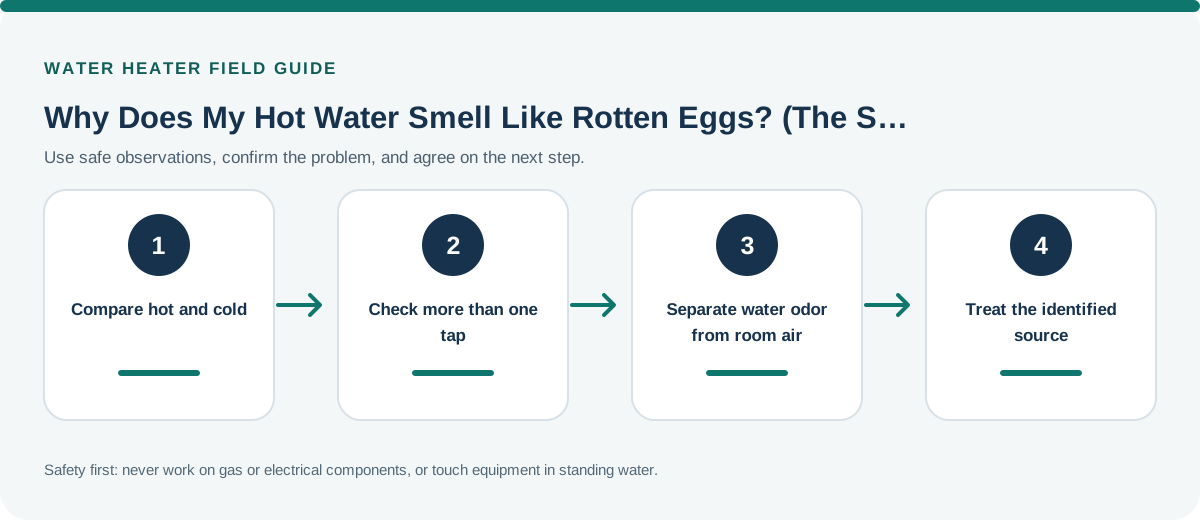
Use this short sequence to collect useful information before arranging service:
- Compare hot and cold water from the same tap using a clean glass, away from the drain.
- Check whether the smell appears at more than one fixture.
- If the odor is in the room air and a gas leak is possible, leave immediately and call from outside.
- Describe the pattern to a provider and ask about the diagnostic plan before approving treatment.
Visual summary
Quick comparison table
| Where the odor appears | Possible source | Safer next step |
|---|---|---|
| Hot water only, several fixtures | The heater or hot-water plumbing may be involved | Ask about tank, anode, and water-quality checks. |
| Hot and cold water both smell | Supply or treatment system may be involved | Ask about water testing and the source before changing the heater. |
| One sink drain smells but a water sample does not | The drain may be the odor source | Investigate the drain separately from the water heater. |
| Odor in room air near gas equipment | Possible gas hazard | Leave the area; call the gas utility or emergency service from a safe location. |
Benefits and trade-offs
What helps
- The hot-versus-cold test can help separate likely water-heater issues from supply or drain issues.
- A source-based diagnosis reduces the risk of treating the wrong system.
What to avoid or consider
- The smell alone cannot prove that the water is safe or identify the cause.
- Removing an anode rod or adding chemicals without proper guidance can damage the heater or create safety concerns.
For why does my hot water smell like rotten eggs? (the sulfur solution), use this table as a comparison aid, not a substitute for site-specific diagnosis; equipment design, installation, condition, and property requirements can change the right response.
Frequently asked questions
Is rotten-egg-smelling hot water always caused by the heater?
No. The source can be the heater, the incoming supply, water treatment, or a drain. Compare hot and cold water and more than one fixture.
Should I remove the anode rod?
No. The rod protects the tank from corrosion. A qualified professional should decide whether a compatible alternative is appropriate.
Can I pour bleach into the water heater?
Do not improvise a chemical treatment. The correct procedure depends on the system and water source; ask a qualified professional and follow equipment instructions.
What if I smell gas near the heater?
Leave the property, avoid switches and flames, and call the gas utility or emergency services from a safe location outside.
What is the safest first step for hot water smells like rotten eggs?
For hot water smells like rotten eggs, identify the symptom safely, record when it occurs, and stop troubleshooting if gas, electrical, or active flooding hazards are present.
Final takeaway
The useful clue is where the odor occurs: hot water only, hot and cold water, one drain, or the air near an appliance. Identify that pattern before choosing a treatment, and treat suspected fuel gas as an immediate safety issue.
For hot water smells like rotten eggs, keep the immediate safety steps separate from the longer-term repair or replacement decision. Confirm the provider, fee policy, and written scope before authorizing work.
Further reading: Penn State Extension guidance on hydrogen sulfide odor in water.