
Quick answer
Gas systems use combustion and need appropriate fuel supply, combustion air, and venting. Electric resistance systems rely on an electrical circuit and do not burn fuel at the unit. The right choice depends on available utilities, demand, efficiency, installation cost, and the property’s requirements.
For gas vs electric water heaters, the most useful first step is to identify the symptom safely and record when it occurs. Do not open a gas or electrical appliance or bypass a safety device to test a theory.
Readers searching for gas vs electric water heaters should separate observations from assumptions: a symptom can point to several causes, and the equipment needs a site-specific diagnosis before a repair is chosen.
Operating cost is a calculation
To compare bills, use the unit’s energy factor or uniform energy factor as applicable, expected household hot-water use, and the actual local price of the energy source. A high-efficiency unit can still cost more to operate if the energy price or usage pattern differs.
Ask for the model’s efficiency data and use your own utility rates. Avoid relying on a generic monthly-savings promise.
Performance and recovery
A storage tank’s recovery depends on capacity and heating input. Tankless delivery depends on flow and temperature rise. Household routines matter: multiple showers at once create a different demand than one shower followed by a long recovery period.
Describe the busiest hot-water periods and whether the current system runs out or struggles to recover.
Installation and safety differences
Gas systems require suitable fuel supply, venting, combustion air, and safe startup checks. Electric systems require a compatible circuit, wiring, and disconnect. Either type needs sound plumbing connections, leak checks, clearances, and compliance with the applicable rules.
Do not attempt gas-line, venting, or high-current electrical work yourself. Get a site-specific scope from the actual contractor.
Lifespan and maintenance
There is no fixed lifespan for every model. Water quality, installation, usage, maintenance, corrosion, and the condition of serviceable components all matter. The best time to compare options is before a failure becomes an emergency, unless an active hazard must be handled first.
Ask what maintenance is expected, which parts may be serviced, and how warranty coverage is affected by the installation.
For gas vs electric water heaters, compare the installed system and local utility rates rather than relying on a universal cost claim.
For this question—gas vs electric water heaters—use the table below to compare the possible explanations and the next useful action, rather than replacing a part based on one clue.
What to do next
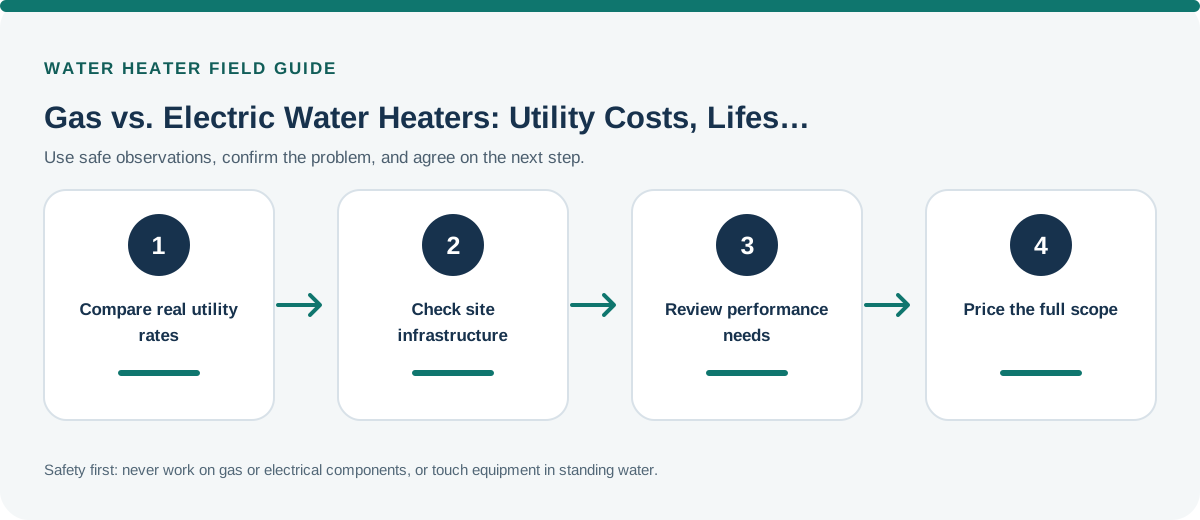
Use this short sequence to collect useful information before arranging service:
- Record the current fuel type, tank or tankless design, capacity, and any recurring fault.
- Compare actual utility rates and efficiency information for candidate systems.
- Price the complete installation, including venting or circuit work and permits where needed.
- Ask about maintenance, safe operation, and written warranty conditions before deciding.
Visual summary
Quick comparison table
| Factor | Gas system | Electric system |
|---|---|---|
| Fuel availability | Needs a suitable gas supply | Needs a suitable electrical circuit |
| Installation checks | Gas line, venting, combustion air, clearances, startup | Circuit capacity, wiring, disconnect, safe energizing |
| Operating cost | Depends on gas rates, efficiency, and use | Depends on electricity rates, efficiency, and use |
| Performance | Depends on input, capacity, and design | Depends on input, capacity, and design |
| Maintenance focus | Combustion/venting and equipment-specific checks | Electrical controls and equipment-specific checks |
Benefits and trade-offs
What helps
- Gas: can suit properties with adequate gas infrastructure and the right equipment design.
- Electric: avoids on-site combustion and venting and can suit properties with adequate electrical service.
What to avoid or consider
- Gas: venting and fuel-line requirements add safety and installation considerations.
- Electric: circuit capacity and local electricity prices can affect feasibility and operating cost.
For gas vs. electric water heaters: utility costs, lifespans, and performance, use this table as a comparison aid, not a substitute for site-specific diagnosis; equipment design, installation, condition, and property requirements can change the right response.
Frequently asked questions
Which is cheaper to run?
There is no universal answer. Compare local energy rates, equipment efficiency, usage, and the installed system.
Which lasts longer?
Lifespan varies by design, water quality, maintenance, installation, and use. Do not rely on fuel type alone to predict it.
Can I switch from gas to electric?
Possibly, but the electrical circuit, location, capacity, and permit requirements need assessment. A fuel change is not just an appliance swap.
Which is safer?
Both can operate safely when correctly installed and maintained. Gas systems require proper combustion and venting; electric systems require appropriate electrical installation and protection.
What is the safest first step for gas vs electric water heaters?
For gas vs electric water heaters, identify the symptom safely, record when it occurs, and stop troubleshooting if gas, electrical, or active flooding hazards are present.
Final takeaway
Compare gas and electric by actual utility rates, efficiency, capacity, installation requirements, maintenance, and the property’s infrastructure. A site-specific written proposal is more useful than a generic “cheaper” claim.
For gas vs electric water heaters, keep the immediate safety steps separate from the longer-term repair or replacement decision. Confirm the provider, fee policy, and written scope before authorizing work.
Further reading: U.S. Department of Energy overview of water-heater efficiency standards.