
Quick answer
Many conventional storage tanks are often discussed in a broad range of roughly eight to twelve years, while tankless systems can last longer under suitable conditions. These are general expectations, not guarantees. Use the equipment label, manual, maintenance history, and current condition for a real decision.
For how long does a water heater last, the most useful first step is to identify the symptom safely and record when it occurs. Do not open a gas or electrical appliance or bypass a safety device to test a theory.
Signs that deserve attention
Rust-colored water, persistent leaks, new rumbling, inconsistent temperature, reduced recovery, and repeated shutdowns can indicate wear or a component fault. None of these symptoms alone proves that the tank must be replaced.
The exception is a tank shell that has corroded through: it cannot be safely restored by patching. Active leaks and safety hazards need prompt attention.
Age versus condition
A well-maintained unit may outlast another of the same age, while a poor installation or adverse water conditions can shorten service life. Ask whether the problem is a replaceable component or damage to the vessel itself.
Record the approximate installation date, previous repairs, visible corrosion, and how performance has changed.
Compare the full decision
A repair estimate should identify the failed part and any related wear. A replacement estimate should include the new unit, removal, installation changes, required permits, startup checks, and warranty terms. Compare both scopes rather than comparing a part price to an equipment sticker price.
For an older unit with recurring failures, ask the provider to explain why another repair is expected to be worthwhile or why replacement is being recommended.
Plan before failure when possible
If the unit is aging but working, researching options in advance gives time to check capacity, fuel, space, access, and permit requirements. If the tank is actively leaking or there is a gas/electrical hazard, safety takes priority over planned shopping.
A planned decision is easier to make with a current equipment photo, measurements, and a record of the hot-water demand.
What to do next
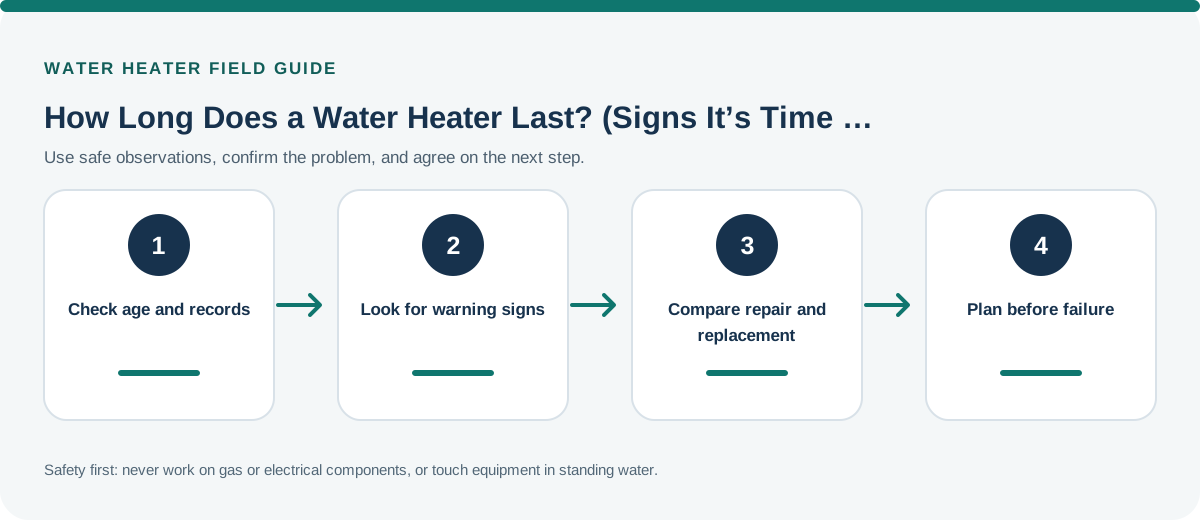
Use this short sequence to collect useful information before arranging service:
- Find the unit’s age or installation records if available.
- Look for visible corrosion, leaks, performance changes, and repeated faults without opening the unit.
- Ask for a diagnosis and compare repair with full replacement scope.
- Confirm equipment sizing, utility requirements, permits, and warranty conditions before authorizing replacement.
Visual summary
Quick comparison table
| Condition | How to interpret it | Next step |
|---|---|---|
| Age only, no performance problem | Age is a planning signal, not proof of failure | Check condition and begin comparing suitable options. |
| Recurring faults or weak recovery | Could be a component issue or broader wear | Request diagnosis and compare repair history with replacement scope. |
| Tank shell leak or severe corrosion | Tank failure likely | Prioritize safety and replacement planning. |
| New noise or rusty water | May indicate sediment, corrosion, or another fault | Record symptoms and seek assessment rather than guessing. |
Benefits and trade-offs
What helps
- Planning before a breakdown allows time to compare equipment and installation scope.
- A confirmed repairable fault may avoid premature replacement.
What to avoid or consider
- Waiting for a failing tank can turn a planned replacement into an urgent job.
- Replacing based only on age may overlook a simple repairable component.
For how long does a water heater last? (signs it’s time for a replacement), use this table as a comparison aid, not a substitute for site-specific diagnosis; equipment design, installation, condition, and property requirements can change the right response.
Frequently asked questions
Is eight to twelve years a hard limit?
No. It is a broad rule of thumb for many storage tanks, not a guarantee. Actual life varies with water quality, installation, maintenance, use, and condition.
Does rusty water mean I need a new heater?
It may indicate corrosion or another water-quality issue. The source should be diagnosed before choosing a repair or replacement.
Can a leaking tank be repaired?
If the tank body itself has corroded through, it generally needs replacement rather than patching. A fitting leak may be repairable.
What should a replacement estimate include?
Equipment, removal/disposal, installation work, utility changes, permits, testing, and warranty details.
What is the safest first step for how long does a water heater last?
Start with the topic-specific first section, record what you observe safely, and stop if gas, electrical, or active flooding hazards are present.
Final takeaway
Use age to plan, not as the only reason to replace. Current condition, repeated faults, tank-shell integrity, hot-water demand, and a clear written comparison should drive the decision.
For this topic, keep the immediate safety steps separate from the longer-term repair or replacement decision. Confirm the provider, fee policy, and written scope before authorizing work.
Further reading: City of Boca Raton electric changeout checklist and gas/tankless changeout checklist (for properties within city jurisdiction).