
Quick answer
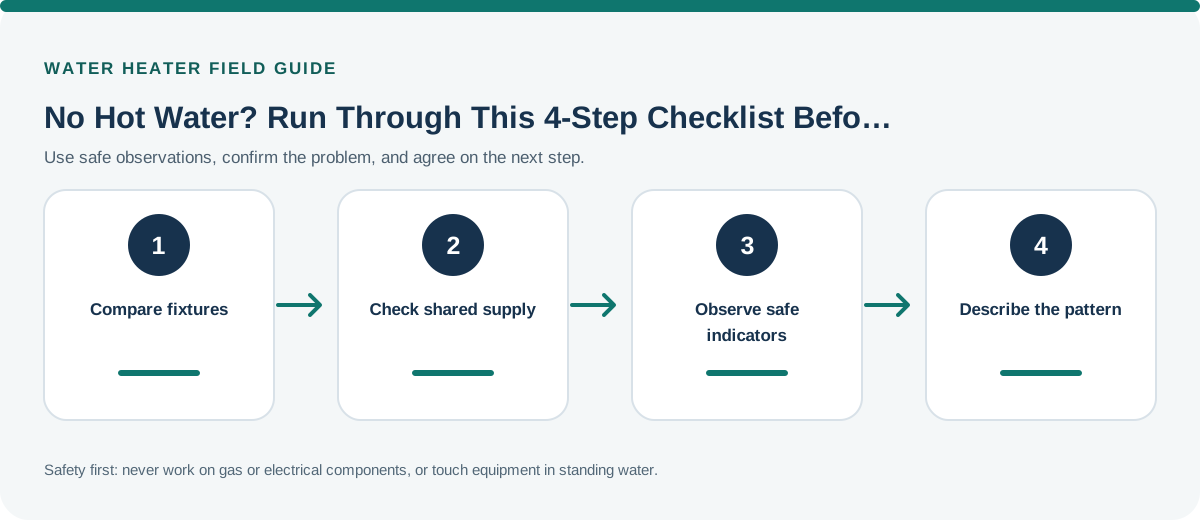
Compare fixtures, check for a wider supply interruption, look only at normal user-visible controls or fault indicators, and record any leak, odor, noise, or error code. Stop immediately if there is a gas odor, burning smell, water near electrical equipment, or repeated breaker trip.
For no hot water checklist, the most useful first step is to identify the symptom safely and record when it occurs. Do not open a gas or electrical appliance or bypass a safety device to test a theory.
Readers searching for no hot water checklist should separate observations from assumptions: a symptom can point to several causes, and the equipment needs a site-specific diagnosis before a repair is chosen.
Step 1: Compare two or more fixtures
Try another hot tap if it is safe to do so. If one shower is cold while other taps deliver hot water, the issue may be a local mixing valve or fixture rather than the water heater. If every hot tap is affected, the heater or wider supply becomes more likely.
Record which fixtures work and which do not. This simple distinction can save time during diagnosis.
Step 2: Check whether the issue is wider
If the property is in a condo or managed building, ask whether neighbors or common areas have the same problem. A building-level supply or maintenance issue can look like a private heater fault.
Do not manipulate shared valves or equipment. Contact the person responsible for the building when a shared system may be involved.
Step 3: Observe only safe, visible indicators
Look for a display or indicator intended for the user and record any code exactly. You may check normal settings described in the user manual, but do not remove access covers, work on wiring, relight repeatedly, or bypass a safety control.
A breaker that trips again, a burning odor, a gas smell, or water near the electrical parts is a stop signal, not an invitation to reset the system.
Step 4: Prepare a useful service request
Write down tank or tankless, gas or electric if known, the approximate age, when the failure began, and whether hot water stopped suddenly or faded over time. Mention any recent work, unusual noise, or leak.
Ask about current availability, diagnostic fees, and what the assessment includes. A phone description can narrow the path but cannot confirm every internal fault.
Use this no hot water checklist to collect safe observations, not to diagnose or open internal components.
This no hot water checklist is most useful when it records which fixtures work, whether the failure was sudden, and any safe visible code.
For this question—no hot water checklist—use the table below to compare the possible explanations and the next useful action, rather than replacing a part based on one clue.
What to do next
Use this short sequence to collect useful information before arranging service:
- Compare hot water at more than one fixture.
- Ask whether the issue affects a whole building or only your property.
- Record safe visible indicators and stop if there is an electrical, gas, or active leak hazard.
- Call with the symptom pattern and ask about availability and fees.
Visual summary
Quick comparison table
| Pattern | What it may suggest | What to record |
|---|---|---|
| One fixture affected | Local faucet or mixing component may be involved | List which fixtures work and which are cold. |
| All hot taps affected | Heater or supply issue may be involved | Describe fuel type, unit type, and any visible code. |
| Hot water fades quickly | Capacity, recovery, or heating fault may be involved | Explain how long hot water lasts and whether this is new. |
| Gas odor, burning smell, or wet electrics | Safety hazard possible | Stop troubleshooting and move to the appropriate emergency response. |
Benefits and trade-offs
What helps
- A short checklist helps you share facts rather than guess at a failed part.
- It can reveal whether a fixture, building supply, or heater deserves first attention.
What to avoid or consider
- It is not a substitute for electrical, gas, or appliance diagnosis.
- Repeated resets can hide a recurring fault or create a hazard.
For no hot water? run through this 4-step checklist before you call a pro, use this table as a comparison aid, not a substitute for site-specific diagnosis; equipment design, installation, condition, and property requirements can change the right response.
Frequently asked questions
Should I reset the breaker to restore hot water?
Do not repeatedly reset a breaker that trips. Keep clear and arrange qualified diagnosis, particularly if water or burning smells are present.
Why does only one shower have cold water?
A fixture cartridge or mixing valve may be involved. Compare with other taps and describe the pattern.
Can I tell whether the heating element is bad?
Not reliably from the symptom alone. A qualified person may need to test the circuit and components.
When should I stop and call immediately?
For gas odor, burning smell, water near electrical equipment, active flooding, or a tank that appears to be failing, stop troubleshooting and prioritize safety.
What is the safest first step for no hot water checklist?
For no hot water checklist, identify the symptom safely, record when it occurs, and stop troubleshooting if gas, electrical, or active flooding hazards are present.
Final takeaway
The goal of the checklist is not to fix every fault yourself. It is to describe the scope safely, avoid hazardous trial-and-error, and make the first diagnostic conversation more productive.
For no hot water checklist, keep the immediate safety steps separate from the longer-term repair or replacement decision. Confirm the provider, fee policy, and written scope before authorizing work.
For a local installation, confirm current permit and inspection requirements with the authority responsible for the exact property. The City of Boca Raton publishes electric and gas/tankless changeout guidance for work within city jurisdiction.