
Quick answer
The impact of a commercial failure depends on which fixtures or zones are affected, whether the problem is total or intermittent, the system’s redundancy, operating hours, and the time needed for diagnosis, parts, approvals, and installation. A fast response cannot be guaranteed by a website, so confirm actual provider availability directly.
For commercial water heater failures, the most useful first step is to identify the symptom safely and record when it occurs. Do not open a gas or electrical appliance or bypass a safety device to test a theory.
Triage the impact before choosing the fix
List the affected fixtures, suites, or processes. If one sink is affected but other hot-water points work, the issue may be local. If multiple zones are cold, the central heater, circulation, control, fuel or power supply may be involved.
Protect people first if there is flooding, a gas odor, burning smell, or water near electrical equipment. Do not ask staff to bypass controls or repeatedly reset tripped equipment.
Know the system and the demand pattern
Useful records include tank or tankless design, fuel type, capacity, age, maintenance history, error codes, recirculation setup, and the time of day the failure appears. Demand peaks can reveal a capacity or recovery problem that a simple component replacement will not solve.
If equipment documentation is missing, take a safe photo of the exterior label and describe the site to the provider.
Plan around business continuity
A written work plan should identify the affected areas, shutdown window, access needs, isolation steps, tenant or staff communication, parts, testing, and who can approve the cost. Some work can be scheduled outside peak hours, but the actual timing depends on provider availability and the repair scope.
Ask whether the quote includes diagnostics, after-hours fees, permit handling, commissioning, and a follow-up recommendation.
Repair or redesign?
A component repair may restore service when the equipment remains suitable. Repeated breakdowns, inadequate recovery, or changed occupancy can justify a capacity review or replacement proposal. The decision should be based on evidence and the full scope, not a generic claim that a new system is always better.
Compare downtime risk, equipment condition, energy use, maintenance, and required upgrades in writing.
What to do next
Use this short sequence to collect useful information before arranging service:
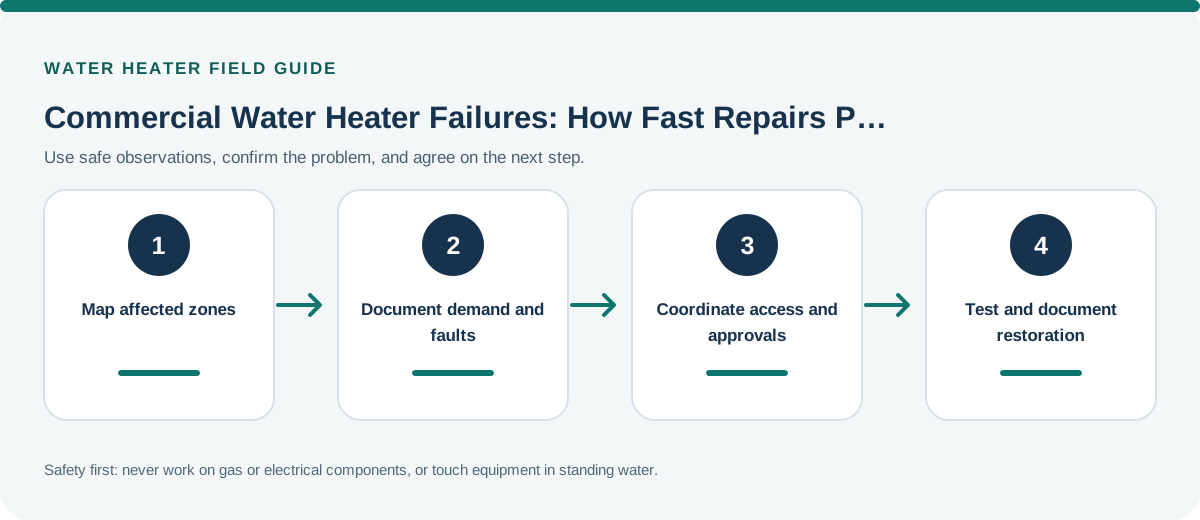
- Map the affected zones and the business functions that rely on hot water.
- Record equipment type, symptoms, fault indicators, maintenance history, and demand timing.
- Confirm provider coverage, current availability, fees, access, and approval process.
- Request a written plan for repair or replacement, downtime, testing, permits, and documentation.
Visual summary
Quick comparison table
| Failure pattern | Operational impact | Useful response |
|---|---|---|
| Single fixture failure | Local fixture or branch may be involved | Map affected points before authorizing a central-system replacement. |
| Multiple zones cold | Central heater, circulation, controls, or utilities may be involved | Share system records and the pattern of affected areas. |
| Hot water fails only at peak times | Demand, recovery, recirculation, or capacity may be involved | Request a demand and recovery review, not only a component swap. |
| Repeated breakdowns | Maintenance, system condition, or sizing may be involved | Compare a repair plan with a documented replacement/capacity option. |
Benefits and trade-offs
What helps
- A clear triage record can help facilities teams make quicker, better-informed decisions.
- A capacity review may address repeat failures rather than only the immediate symptom.
What to avoid or consider
- Commercial jobs can require tenant coordination, work windows, and approval chains.
- An equipment-only quote may omit circulation, controls, utility changes, permits, or commissioning.
For commercial water heater failures: how fast repairs protect your business revenue, use this table as a comparison aid, not a substitute for site-specific diagnosis; equipment design, installation, condition, and property requirements can change the right response.
Frequently asked questions
How quickly can commercial service be arranged?
That depends on current provider availability, location, equipment, parts, and access. Confirm the actual response window directly; the referral line does not guarantee dispatch.
What if only some rooms have no hot water?
Map the affected rooms and compare them with areas that still work. A localized fixture or branch issue can differ from a central heater failure.
Should a business replace an older commercial heater?
Age alone is not enough. Review condition, demand, repair history, recovery, and the full installed replacement scope.
What should be in a commercial estimate?
Diagnosis, equipment or parts, labor, access assumptions, work window, permits, testing/commissioning, exclusions, and the responsible approval contact.
What is the safest first step for commercial water heater failures?
Start with the topic-specific first section, record what you observe safely, and stop if gas, electrical, or active flooding hazards are present.
Final takeaway
Commercial response is strongest when the team knows what is affected, how demand changes during the day, and what constraints govern the site. Use those facts to request a documented plan that balances restoration, safety, and operational continuity.
For this topic, keep the immediate safety steps separate from the longer-term repair or replacement decision. Confirm the provider, fee policy, and written scope before authorizing work.
Further reading: City of Boca Raton multi-family and commercial permit resources.