
Quick answer
A storage tank can be a straightforward option when the installed setup meets demand and the initial budget matters. Tankless can reduce storage footprint and standby losses in suitable installations, but it needs to be sized for simultaneous flow and may require utility or venting changes.
For tankless vs traditional tank water heater, the most useful first step is to identify the symptom safely and record when it occurs. Do not open a gas or electrical appliance or bypass a safety device to test a theory.
Readers searching for tankless vs traditional tank water heater should separate observations from assumptions: a symptom can point to several causes, and the equipment needs a site-specific diagnosis before a repair is chosen.
How a storage tank works
A tank heats and stores a volume of water. The stored supply can serve a large short burst of demand, but it can be depleted and needs time to recover. A tank is often simpler to compare when replacing a similar unit in a suitable location.
Consider the tank’s condition, recovery rate, demand pattern, and whether the existing installation remains appropriate.
How tankless works
A tankless unit heats water on demand, so there is no large storage vessel. Its delivery is limited by the rated flow and the temperature rise required. Running several high-flow fixtures at once can exceed the unit’s capacity.
Ask for a sizing calculation that uses realistic simultaneous use rather than a broad claim of endless hot water.
The installation can decide the result
Changing from tank to tankless may require different gas capacity, venting, electrical service, condensate handling, or plumbing. A tank-to-tank replacement can still need updated connections, drainage, clearances, and permits.
Compare complete installed proposals, not only equipment prices. Ask which upgrades are required and why.
Maintenance and long-term ownership
Both designs need appropriate maintenance. Tankless systems can require scale management according to water conditions and manufacturer guidance; storage tanks may need inspection and flushing as appropriate. Actual lifespan depends on water quality, installation, usage, and maintenance.
Ask what routine maintenance is required, what parts are serviceable, and what warranty conditions apply.
For tankless vs traditional tank water heater decisions, compare simultaneous demand and the complete installation scope.
For this question—tankless vs traditional tank water heater—use the table below to compare the possible explanations and the next useful action, rather than replacing a part based on one clue.
What to do next
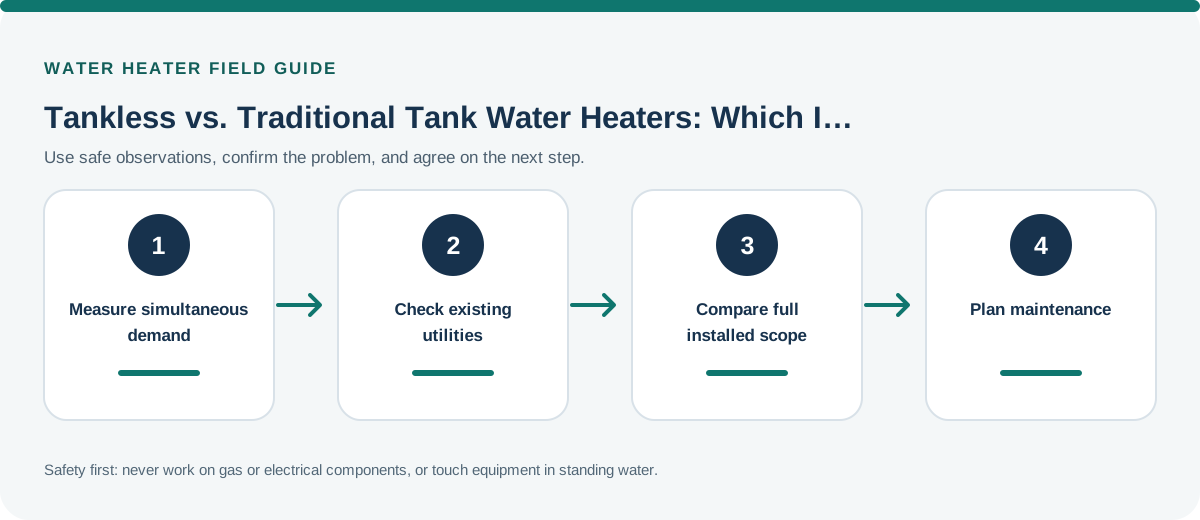
Use this short sequence to collect useful information before arranging service:
- Estimate the fixtures likely to run at the same time.
- Check the current fuel or electrical supply and installation location.
- Compare installed scope, maintenance, and efficiency data for suitable models.
- Choose the system that meets demand with realistic lifetime costs, not a single headline claim.
Visual summary
Quick comparison table
| Decision factor | Traditional tank | Tankless |
|---|---|---|
| Initial installed scope | Often simpler for a like-for-like tank replacement | May need venting, gas, electrical, or condensate changes |
| Hot-water delivery | Stored volume can serve a short high-demand burst | Continuous delivery is limited by rated flow and temperature rise |
| Space | Requires a storage footprint | Usually smaller wall or equipment footprint |
| Maintenance | Tank and components need condition-based service | Scale management and system-specific maintenance may be important |
| Best decision factor | Existing setup, budget, demand, and tank condition | Peak flow, utility capacity, installation feasibility, and usage |
Benefits and trade-offs
What helps
- Tank: familiar design and stored volume for short high-demand periods.
- Tankless: compact form and reduced standby loss when correctly selected and installed.
What to avoid or consider
- Tank: stored hot water can run out and the vessel takes space.
- Tankless: sizing and installation upgrades can be more complex; demand above rated flow can reduce performance.
For tankless vs. traditional tank water heaters: which is best for your home?, use this table as a comparison aid, not a substitute for site-specific diagnosis; equipment design, installation, condition, and property requirements can change the right response.
Frequently asked questions
Does tankless provide unlimited hot water?
No. It can heat water while flow stays within the unit’s rated capacity and required temperature rise.
Which option costs less to install?
A like-for-like tank replacement may be simpler, but the actual cost depends on equipment, labor, access, utilities, permits, and required upgrades.
Is tankless always more efficient?
Not in every real-world installation. Compare equipment efficiency, household use, fuel cost, and the complete installation.
Can hard water affect either type?
Mineral scale can affect hot-water equipment. Test or review the property’s water quality and follow the system’s maintenance instructions.
What is the safest first step for tankless vs traditional tank water heater?
For tankless vs traditional tank water heater, identify the symptom safely, record when it occurs, and stop troubleshooting if gas, electrical, or active flooding hazards are present.
Final takeaway
Choose around the home’s demand and infrastructure. A fair comparison covers installed cost, utility changes, hot-water capacity, space, maintenance, and the condition of the existing system.
For tankless vs traditional tank water heater, keep the immediate safety steps separate from the longer-term repair or replacement decision. Confirm the provider, fee policy, and written scope before authorizing work.
Further reading: U.S. Department of Energy Building Science Education: gas-fired tankless water heaters.